Tuesday, January 15, 2013

the rainy day Barbed wire orb

I'm one of those types of people who has to be doing something. Cold rainy days are no exception. But sometimes you just have to take it inside where its a tad-bit more cozy. This project is perfect for a lounging around kinda day, "the rainy day barbed orb".


the final product


Stage 1, your supplies. All you need is 16gauge annealed wire that cost about $5 bucks at Homedepot, pliers (lineman work best), then get too it...

stage 1. the supplies

Stage 2,  creating the outer diameter of your orb. Cut eight length's of wire (all the same measurement) be sure to double your wire lengths by wrapping the wire around each other. After you doubled the wire you should have (4) lengths of wire at double thickness.

stage 2, cutting outer diameter lengths

Stage 3, make (4ea) hoops with your double thickness lengths of wire. The orb diameter is determined by these four length's.

stage 3, the hoops

Stage 4, connect your hoops together. (3) will go the same way and make up the sphere or orb and (1) will go around the equator of your orb holding securely with a space between each.

Start with the (3) hoops and make a connection at the top of the orb and the bottom of the orb with a 2" piece of wire (these act as the barbs) wrap them both in opposite directions.

stage 4, the orb and its equator

Stage 5,  make the "S scrolls." Your scrolls will all vary in size be sure to make them with a larger and smaller end. This will allow them to fit different area's of each section of your orb.

stage 5, making "S" scrolls

Stage 6, attaching scrolls to each section of orb. When attaching your scrolls the same method is used a 2" piece of wire wrap it around part of the scroll and part of the orb. Attach them in area's that naturally make sense for the scrolls position and shape.

stage 6, attaching "S" scrolls
close up of barb

Stage 7, all the "S" scrolls attached and the orb taking shape. once everything has been attached and each section of orb has its scroll you may need to shape it a bit.

Remember it's a handmade project and there will be imperfections in the shape. Shape it the best you can than leave it alone it's art...

stage 7, shaping the orb


I think these would be a super cool light fixture, but they can be hung as is, or simply placed somewhere next to other items and use it in a grouping.

This project is more of a crafty one for sure. It's super fun, pretty simple, and has that unique not so ordinary look I love!! 


Monday, January 7, 2013

Re-thinking your lighting 2

Several years ago my mother in law gave my wife this really cool vintage birdcage. We always thought of it and used it as a fun rustic outdoor piece until today... BAM another idea on pinterest!! Someone used a vintage birdcage as a light fixture and it immediately made me think of our very cool cage hanging in the yard.

A trip to Lowe's and well here it is a crazy cool custom light fixture.


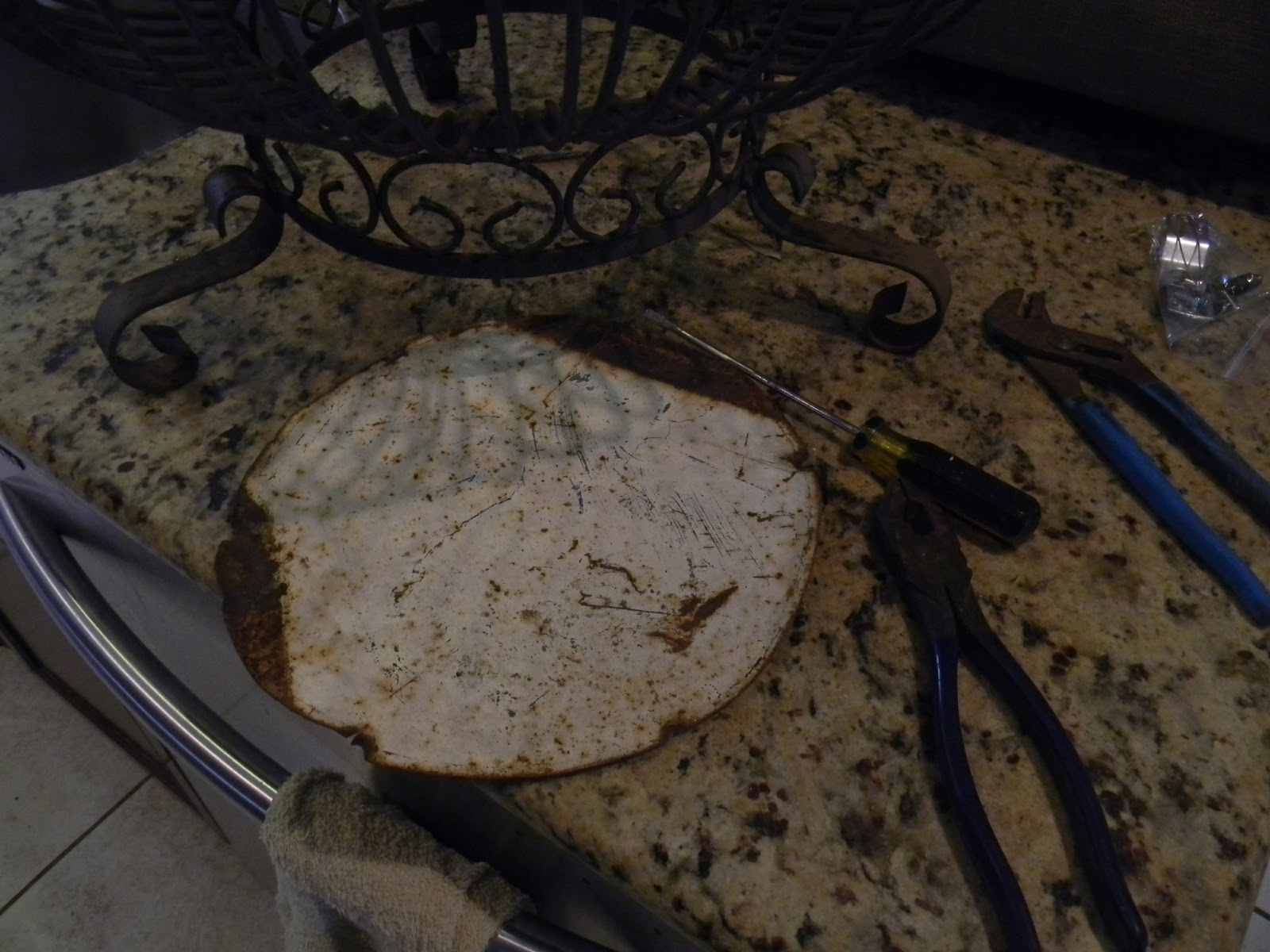
Stage 1, take the bottom out of the cage. Removing the bottom from this cage was pretty simple i just shimmed a couple of flat-head screwdrivers and pry it open a bit to break each weld.


 Stage 2, run the light set up through the top of the cage. All we needed for this project was a light socket, canopy kit, a couple links of chain, and wire. Once you have your light kit wired from the bottom run your wire through your chain and tie a knot at the top to prevent it from falling through. Be sure to add a safety wire to help hold during installation and in case fixture falls it's kinda heavy don't chance it...

stage 2, running the light kit through the cage
stage 2, looking at the light socket
stage 3, the knot tied at the top and safety wire

Stage 4, install the light fixture. I recommend having someone help you hold the fixture. Positive to positive, negative to negative, and ground off the safety wire.

It just happened that my existing fixture's globe was a perfect fit on the inside of the cage hiding the simple rustic look of the socket light. I'm not sure if I'm going with this look or not?

stage 4, installed turned on with the globe
stage 4, existing fixture
stage 4, rustic simple socket look


This project took about 45 minutes, cost about $15 and is going to give the room we put it in a very unique and eclectic vibe. Very nice!! Oh and thanks Pinterest.


Friday, January 4, 2013

little girly glam bench

Something that's really stylish in design right now is distressed furniture. If that furniture has a bit of sparkle or bling it's really hot. This project the little girly glam bench has it all.

Although this is a diy project it will require a bit of skill set with power tools. If you don't have the tools or experience to work with them don't get discouraged. Improvise, find yourself an old piano bench or something that has the look you want and start at the painting and distressing stage.


final product

Stage 1, cutting your 2x stock to the right dimensions and getting the clean line look. Standard 2x material has rounded edges for this project we want to cut off the round edges from both sides of the lumber. Set your table saw to remove a 1/4" then cut it off. Flip the 2x and cut off the other sides rounded edges. This leaves you with 3" instead of the typical 3 1/2" from a standard 2x4."

stage 1, cutting off rounded edges of the 2x4's

Stage 2, determining the bench length. Our project is going to be 40" long and 13" wide. this allows for easy measuring and miters. Pre-cut all your 3" material to the determined lengths (2) @ 40" (2) @ 13." Once your material has been cut you need to miter the corners @45deg. Make sure all the ends are mitered inward to frame out a box.

stage 2, determining length and cutting miters

Stage 3, glue your box together. If you have a pneumatic finish nailer this is a great place to use it (shoot 2" nails) to each corner. If not use deck screws (3") to hold corners together. Be sure to pre-drill or you will split the wood.

stage 3, making the box for the bench

Stage 4, the box is together and needs a center support. Find center of the box and measure the distance, it should be close to 10" (if you used our 13" dimension for sides). Glue, nail, or screw with (3" deck screws) flush with box.

stage 4, adding center support

Stage 5,cut (2) leg supports. For this step use 2x6 material it has a bit more area than a 2x4 and will make for a stabler project. Set into location glue and attach. They should be flush to the bottom of the box opposite your center support. Use (6) total deck screws to attach each support.

stage 5, leg supports
stage 5, counter sink holes to hide 3" deck screw heads
stage 5, what project should look like at this stage

Stage 6, cut out legs. Determine your over all bench height and cut legs according to that distance. the bench box is 3" a comfortable bench height is between 15-18." To be within this height cut your legs at 16-17" square (use 2x6) material and you get 2 legs per piece. Measure over 3 1/3" turn to opposite end and measure out 3 1/2" scribe a line from mark to mark and you have a tapered leg. Add a 15deg cut to each end off the leg to give the legs a simple flair.
 
stage 6, cutting out legs

Stage 7, attaching legs. Turn box right side up grab one of the legs square off in corner and scribe the outline. This allows you to know where to pre-drill holes for deck screws (2ea) per leg.

stage 7, squaring and scribing

Stage 8, glue and attach legs to box. The pre-drilling of the holes will help you to locate the legs to the proper location. Be sure to glue then attach with 3" deck screws.

stage 8, all legs attached

Stage 9, sand entire bench. Plug holes with wood plugs the same size of hole (if you used 1/4" counter sinks glue 1/4" wood plugs in, let sit to dry properly. in the meantime fill in all holes with wood putty, let dry, then sand (course, medium, fine).

stage 9, prepping for sand

Stage 10, base coat. Paint out entire project with base coat (flat black) in our case, sit and let dry.

stage 10, base coat black

Stage 11, top coat. Distressing doesn't have to be difficult and doesn't necessarily require special paints. Because I want our project to have some sparkle the top coat is a Ralph Lauren metallic. I had left over paint from some other projects why not use it. Paint out project let sit and dry.

stage 11, top coat

Stage 12, distressing. Distressing rules can vary I try to keep it simple. Distress area's that are typical ware area's i.e., corners and edges. I also use a variety of distressing tools such as sanding pads, steel wool, and sand papers. Work area until you achieve your desired look. Once that look is achieved steel wool the entire project it really smooths and adds a great look.

stage 12, distressing side
stage 12, distressing corners and edges


Stage 13, cutting out seat from mdf and adding foam. Cut a piece of mdf to your projects over all dimensions. For example ours is 40"x13" that's my mdf dimensions.

With an electric knife cut your foam out to that same dimension and secure to mdf with spray adhesive.

stage 13, cutting mdf and foam
stage 13, adhering foam to mdf

Stage 14, upholstering the seat. Pick out your fabulous material and attach it to the mdf seat. Always start in the middle of your longest edge (it will allow you to stretch fabric evenly). Turn to other side and do the same. Finally you have the small opposing ends fold them up like a present and staple them down.

stage 14, attaching fabric
stage 14, fabric all attached

Stage 15, secure your seat to the bench. I used finish nails along the outer edge of seat they're just small enough to go all the way through the fabric without noticing or damaging your fabric.

stage 15, attaching seat to bench


Projects done!! Another cool, fun, one off  designer piece that had no problem finding it's way out of my hands into my daughters...


Tuesday, January 1, 2013

Re-thinking builder grade lighting

Custom lighting is a great way to elevate a space from functional and boring to fun and soaring. But custom lighting is extremely expensive. Why not re-think your existing fixtures? There just might be the basis of a fun fabulous custom one off designer light.

Our entry way is our jump off point for this project. We have a builder grade light, that again, is functional but doesn't shout out with any personality. Let's kick it up so that it shouts with uniqueness!!

the final product

Stage 1, take some time and really consider some different possibilities for a light. Think about materials you like, the way your lights being used currently, and the way its constructed. All of this will help you come to a clever and hopefully successful new and fresh approach for it.

stage 1, assessing the boring builder grade fixture

Stage 2, the new idea. Once you've designed something in your head and have the plan of attack go for it. I've found this to be the most crucial stage in any project. Idea's come but the execution of the idea often stays in my head. JUST GO FOR IT!!

For my fixture I'll be using the following materials: Some of the existing light fixture, 1ea. 4x8' galvanized corrugated sheeting, mdf, 3/8" sisal rope, and self taping hex head screws 8-18x3/4"

stage 2, galvanized sheeting and mdf

Stage 3,  getting started. In this project the first thing was to know my fixtures overall dimension (it's going to be 18"dia.). Cut out 2pcs of mdf @ 20" square these will be the structure for the entire project. Take a few course drywall screws and screw in to the squares in a few places (this will help keep the pieces together while cutting out.

stage 3, cutting outer diameter of supports


Stage 4, sand outer diameter. Using a 60 grit paper sand edges and if needed true up the diameter just a bit (it doesn't need to be perfect).

stage 4, sanding the O.D. and edges
stage 4, profile of both pieces

Stage 5, preparing and cutting the inner diameter. I would like the width of my fixture to be 1 1/2" a quick way to do this is by using a piece of 2x4. Take your 2x4 and a pencil and set at the edge of the O.D. take your hand and grab the 2x4 extend your fingers down far enough that they touch and follow the O.D. With your other hand get your pencil ready to follow and scribe the line as it moves around the O.D. (it's awkward but works well). Once inner diameter is scribed drill a through hole large enough for a jig saw blade to fit then cut out the I.D.

stage 5, scribing the inner diameter
stage 5, drill a through hole for saw blade and cut


Stage 6, sand the inner diameter of supports. Sanding process is the same as the outer diameter with one exception each ring is sanded individually.

stage 6, sanding inner diameter of supports

Stage 7,  paint the supports. I want this fixture to have a modern rustic look so I'm painting it out in an espresso tone. Let dry and move on to next stage if project allows.

stage 7, painting out the supports

Stage 8, cutting the galvanized sheeting side panels. The galvanized sheeting comes in 2'x8' sheets. My project needs 2pcs @ 24" square. This leaves the fixture with open sides and will allow another material to be used giving the fixture more interest. Measure down the sheet to 24" and scribe a line with a sharpie then take metal snips and cut your sheet. I totally recommend using gloves when working with this material.

stage 8, cutting out side panels

Stage 9, adding a bit more touch of modern. I like the look of light reflecting on walls and shinning through light fixtures. With this fixture we made random circles to help achieve that look. Using a can we scribed random circles, drilled a hole at the edge of line, snipped them out, and that's it a modern fun look .

stage 9, scribing random circles
stage 9, drill through holes and snip

Stage 10,  drilling holes along the side to add sisal rope stitching. Stack the two side panels on top of each other and drill stitching holes. The sisal rope is 3/8" so you want your holes a tad bit larger 7/16" works well. Be sure to drill in the channel and space every 1"-1 1/2".

stage 10, looking at stitch holes

Stage 11, attaching side panels to support rings. I created a simple jig to help a 2x4 long enough to hold both rings and the panel. Using an impact driver and the self taping hex heads secure panel at every channel. Attach one side at a time following the edge of the support ring. Once that side is done start installing the other side the same way. Rotate your fixture and install the other panel. Keep in mind the gap between panels you'll need to center the panel and equalize the two gaps.

stage 11, installing the side panels

stage 11, what fixture should look like at this stage
stage 11, the fixture with both panels and equal gap

Stage 12, stitching the sides with sisal roping. Estimate the length of rope needed and be sure to cut extra (if the ropes to short you'll have to start over) not fun... Also tape the end of rope it will make it easier to thread the holes. Make a knot at one end and start at the top hole and lace down skipping every other hole.

stage 12, stitching the sides

Stage 13, adding the mounting hardware for the fixture. Our existing fixture had this frame that held the glass globe. This frame is going to be perfect for re-attaching the new light fixture and using all existing mounting hardware. I just needed to pre-drill holes that would allow me to attach the frame to the new fixture. This reverts back to the first stage assessing what and what can be done. The more effort in the front end of the project hopefully results to less problems at the end.

stage 13, pre-drilling screw holes for mounting
stage 13, mounting frame attached and project hanging

This was another project that easily became a favorite when finished. Now when you walk in to the house good bye boring... you can't help from seeing an extremely unique, rustic, but modern, custom light fixture that cost less than $20 bucks, no joke!!